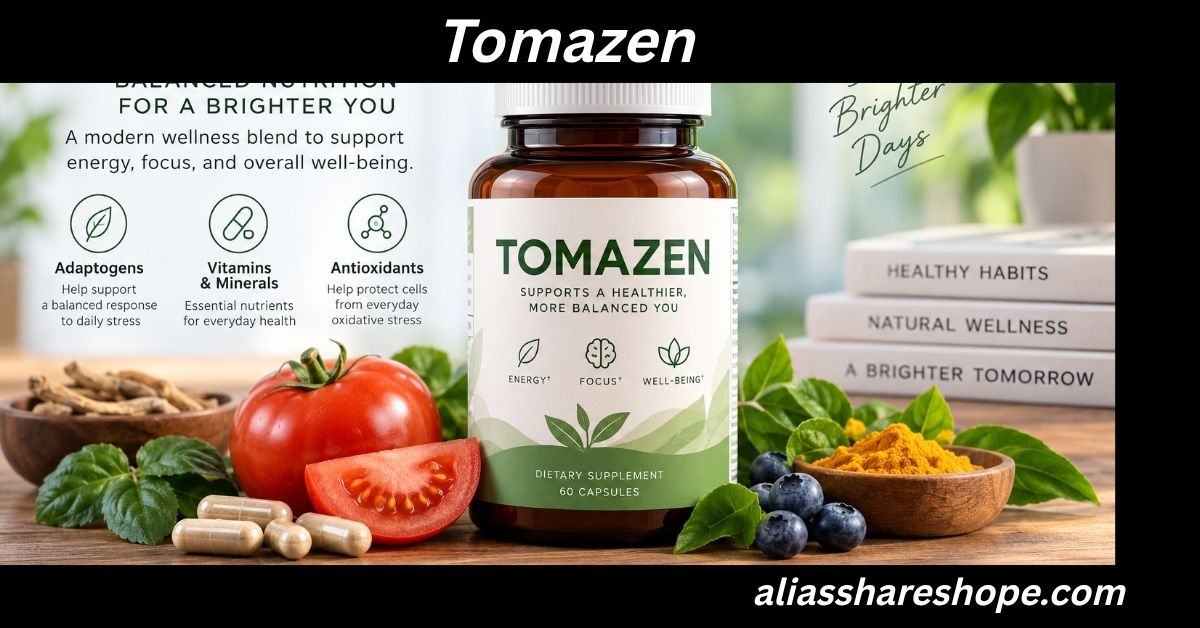
Tomazen: Everything You Need to Know About This Wellness Blend
Tomazen is a wellness-related name that may appear in online discussions about supplements, nutrition, adaptogens, antioxidants, vitamins, energy, focus, and general well-being. However, one important fact should be clear from the beginning: Tomazen does not currently appear to have one universally recognized formula or one clearly established definition.
Some online descriptions present Tomazen as a broader wellness blend involving adaptogens, vitamins, antioxidants, or ingredients associated with focus and energy. Other online material describes the term as a tomato-derived antioxidant supplement concept. Because these descriptions do not agree, consumers should not assume that every product or website using the name Tomazen contains the same ingredients.
That distinction matters.
When a supplement name is not tied to a clearly documented manufacturer, Supplement Facts panel, serving size, ingredient quantities, and quality information, it is difficult to evaluate its safety or potential benefits accurately. The right approach is therefore to understand what the term may refer to, learn how wellness supplements are evaluated in the United States, and check the actual product label before making a purchase or taking anything.
This guide explains what Tomazen may mean, what Tomazen may contain, why formulas can differ, how to evaluate supplement claims, possible benefits and limitations, safety considerations, buying advice, and important questions consumers should ask.
What Is Tomazen?
Tomazen appears to be a wellness-related term rather than the name of one universally standardized nutritional ingredient.
Current online references describe the term in different ways. One source describes Tomazen as a wellness formulation associated with botanical extracts and micronutrients, including possible adaptogens, vitamins, antioxidants, and ingredients intended to support calm focus and general vitality.
Another source uses Tomazen to describe a tomato-centered supplement concept, particularly one focused on lycopene and other compounds found in tomatoes.
These descriptions are substantially different.
For that reason, it would be misleading to say that Tomazen always contains one particular ingredient or delivers one specific health effect.
A better way to understand the term is as a potentially variable wellness or supplement label. The actual meaning depends on the product, manufacturer, website, formulation, and marketing materials connected to the name.
Consumers searching for Tomazen should therefore focus less on the name itself and more on the evidence behind the specific product.
The most useful questions are:
- Who makes the product?
- What exactly is in it?
- How much of each ingredient is provided?
- What is the recommended serving?
- Is there a complete Supplement Facts panel?
- Are proprietary blends used?
- Are ingredient amounts disclosed?
- Is there independent quality testing?
- What claims does the manufacturer make?
- Are those claims supported by credible evidence?
These questions can reveal much more than the product name alone.

Why Tomazen May Have Different Meanings Online
One reason Tomazen can be difficult to research is that wellness terminology is often used differently across websites.
A supplement may have a brand name, a product name, a formula name, or a search term that is later used by other websites to describe a broader category. In some cases, articles may also repeat information from other websites without providing a primary source.
This can create a problem for consumers.
If one website says Tomazen is an adaptogenic wellness blend while another says it is a tomato-derived antioxidant formula, readers may assume both websites are discussing the same product. They may not be.
This is an important digital-literacy lesson for supplement research: identical or similar names do not automatically mean identical products.
The name Tomazen should therefore not be treated as proof of a standardized ingredient profile.
What May Tomazen Contain?
Because there is no clearly established universal Tomazen formula in the available information, possible ingredients should be discussed as examples rather than confirmed ingredients.
Depending on the specific product being described, a wellness blend associated with the Tomazen name may potentially contain categories such as adaptogens, vitamins, minerals, antioxidants, botanical extracts, amino acids, or focus-supporting nutrients.
ALSO rEAD: Why Is My Aliasshareshop.com Payment Being Declined?
The exact contents must be confirmed from the product’s own label.
Adaptogens
Adaptogens are a broad category of plant-based substances commonly marketed for stress resilience, energy, or general wellness.
Examples sometimes associated with wellness formulas include:
- Ashwagandha
- Rhodiola
- Holy basil
- Other botanical extracts
However, an ingredient should not be considered part of Tomazen simply because it appears in another wellness formula.
If a product contains an adaptogen, consumers should look for its exact botanical name, plant part, extract ratio or standardization when relevant, and amount per serving.
Different extracts can have very different characteristics.
Vitamins
Some wellness blends use vitamins to support normal nutritional needs.
Potential examples include:
- Vitamin C
- Vitamin D
- Vitamin E
- B vitamins
The presence of a vitamin does not automatically mean that taking more of it produces a greater health benefit.
For example, someone who already receives enough of a nutrient from food and other supplements may not need additional amounts. Total daily intake matters.
Minerals
A wellness formula may also contain minerals such as magnesium or zinc.
Minerals are essential nutrients involved in many normal body functions. However, excessive intake can also be problematic for some nutrients.
This is why the amount per serving matters just as much as the ingredient name.
Antioxidants
Antioxidants are another common theme in wellness marketing.
If Tomazen is being used to describe a tomato-derived formula, lycopene may be relevant. Lycopene is a carotenoid naturally found in tomatoes and is widely studied as a dietary antioxidant.
Some online material specifically describes Tomazen as a concentrated tomato-based supplement centered on lycopene.
However, that description should not be automatically applied to every product using the Tomazen name.
Other antioxidant ingredients can include plant polyphenols, carotenoids, vitamin C, vitamin E, or botanical extracts.
Focus-Supporting Ingredients
Some wellness products are marketed toward people interested in concentration, mental clarity, or sustained energy.
Depending on the actual formulation, such products may use ingredients such as L-theanine, certain B vitamins, botanical extracts, amino acids, or other nutrients.
The marketing phrase “focus support” should not be confused with a proven treatment for attention disorders, fatigue-related medical conditions, or neurological diseases.
A supplement and a medical treatment are not the same thing.
Tomazen and Adaptogens
Adaptogens are frequently discussed in modern wellness culture because consumers are interested in managing everyday stress and maintaining energy.
Ashwagandha, rhodiola, and holy basil are examples that appear in various wellness formulations.
Research on individual botanicals can be useful, but it should not automatically be used to prove that a product containing those ingredients works exactly as advertised.
There are several reasons.
First, the dose matters.
Second, the form of an ingredient matters.
Third, research on an isolated ingredient does not necessarily prove that a multi-ingredient product has the same effect.
Fourth, studies may involve different populations, durations, extracts, and outcomes.
Therefore, if a Tomazen product contains an adaptogen, consumers should evaluate evidence for the specific ingredient and the specific dose rather than relying on the general reputation of the botanical.
Tomazen and Antioxidants
Antioxidants are compounds that can help protect cells from oxidative processes.
Many foods naturally contain antioxidant compounds. Fruits, vegetables, nuts, seeds, herbs, tea, and other plant foods can contribute to overall dietary antioxidant intake.
Tomatoes are particularly notable for compounds such as lycopene.
If a Tomazen product is specifically tomato-based, its label should identify the tomato ingredient and explain how much is provided.
A consumer should also distinguish between the presence of an antioxidant and a claim that an antioxidant supplement prevents a disease.
Those are not equivalent statements.
The U.S. Food and Drug Administration regulates different categories of supplement claims differently. Certain structure/function claims may be used when requirements are met, but they are not the same as FDA-approved disease claims.
Potential Tomazen Benefits: What Can Reasonably Be Said?
Potential benefits depend entirely on the actual ingredients.
If a Tomazen product contains vitamins or minerals, those nutrients may contribute to normal physiological functions when consumed in appropriate amounts.
If it contains botanicals, the possible effects depend on the specific botanical and its dose.
If it contains antioxidants such as lycopene, the discussion should focus on the evidence for those individual compounds.
If it contains focus-oriented ingredients, claims should be evaluated against human clinical evidence rather than marketing language.
It is therefore better to discuss Tomazen in terms of potential nutritional support rather than guaranteed results.
General Wellness Support
A properly formulated nutritional supplement may help fill specific nutritional gaps.
However, supplements work best as additions to a healthy lifestyle, not replacements for a balanced diet.
For most adults, basic health foundations remain important:
- Adequate sleep
- Regular physical activity
- A varied diet
- Adequate hydration
- Stress management
- Routine medical care
- Avoiding tobacco
- Moderate or no alcohol consumption
A supplement cannot compensate for consistently poor sleep, inadequate nutrition, or an untreated medical condition.
Stress and Calm
If a particular Tomazen formula contains ingredients studied for stress-related outcomes, it may be marketed for calmness or stress resilience.
That does not mean it should be described as a treatment for anxiety or another mental health condition.
Consumers experiencing persistent or severe symptoms should speak with an appropriate healthcare professional rather than attempting to replace professional care with a supplement.
Focus and Mental Clarity
Some ingredients used in wellness formulas are marketed for mental clarity and focus.
The evidence can vary considerably.
A product containing caffeine, for example, may produce a noticeable short-term increase in alertness, while a botanical or nutrient may have a different and less immediate effect.
Consumers should look for exact quantities and avoid assuming that a long ingredient list means greater effectiveness.
Antioxidant Support
If Tomazen contains antioxidant compounds, those ingredients may contribute to normal antioxidant defenses.
However, antioxidant marketing can easily become exaggerated.
The existence of oxidative stress does not mean that taking a high-dose antioxidant supplement will automatically improve health.
More is not always better.
Tomazen Ingredients vs. Tomazen Product Claims
One of the most important distinctions in supplement research is the difference between an ingredient and a product claim.
Suppose a product contains vitamin C.
That fact can be verified on the label.
A separate claim such as “supports immune health” is a statement about the intended role of that ingredient or product.
A stronger claim such as “prevents infections” is very different and may raise regulatory and scientific concerns.
FDA explains that dietary supplement structure/function claims are subject to specific requirements and are not generally pre-approved by FDA. Companies making these claims must have substantiation that the claims are truthful and not misleading.
This is why consumers should read supplement marketing carefully.
How to Read a Tomazen Supplement Facts Label
If you are considering a product marketed as Tomazen, the Supplement Facts panel should be one of the first things you examine.
Look for the following information.
Serving Size
The serving size tells you how much the listed amounts apply to.
For example, a label might define one serving as one capsule, two capsules, or a measured amount of powder.
Never compare products only by the number of capsules in a bottle.
Compare the active ingredients per serving.
Ingredient Amounts
A high-quality label should tell you how much of relevant nutrients or active ingredients are present.
If an ingredient is included in a proprietary blend and the individual amounts are hidden, it becomes harder to determine the dose of each component.
Botanical Details
For plant ingredients, look for the botanical name when available.
The common name alone may not provide enough information.
Extract details can also be useful because different extraction methods and standardizations can affect the final product.
Other Ingredients
Check for:
- Capsules or tablet materials
- Sweeteners
- Flavors
- Fillers
- Preservatives
- Allergens
- Other inactive ingredients
This can be especially important for people with food allergies or dietary restrictions.
Why Proprietary Blends Deserve Extra Attention
A proprietary blend groups multiple ingredients together and may disclose only the total amount of the blend rather than the amount of each individual ingredient.
This can make evaluation difficult.
For example, if a blend contains five botanicals but only gives the total weight, consumers may not know whether one ingredient is present at a meaningful amount or only a very small amount.
That does not automatically make a product unsafe or ineffective.
It simply reduces transparency.
For informed buying decisions, greater ingredient-level transparency is generally easier to evaluate.
Is Tomazen FDA Approved?
Consumers should be careful with the phrase “FDA approved.”
FDA generally does not approve dietary supplements in the same way it approves prescription drugs.
The agency explains that manufacturers and distributors are responsible for ensuring that dietary supplements are not adulterated or misbranded and that applicable claims are truthful and not misleading. FDA also regulates manufacturing requirements and conducts post-market oversight.
Therefore, a website saying that a supplement is “FDA approved” should be examined carefully.
A product being legally marketed as a dietary supplement is not the same thing as an FDA approval of its effectiveness.
Similarly, the presence of an FDA-related logo or statement does not necessarily mean that FDA endorses a particular brand.
FDA specifically warns against misuse of its logo to suggest endorsement of private products or services.
How to Evaluate Tomazen Health Claims
When reading a Tomazen advertisement or product page, divide statements into three groups.
Group One: Verifiable Facts
Examples include:
- The serving size
- Ingredient names
- Amounts per serving
- Number of servings
- Manufacturer information
- Expiration date
- Storage instructions
These can often be checked directly on the package.
Group Two: Structure or Function Claims
These are statements about how nutrients or ingredients may support normal body functions.
FDA recognizes this category of dietary supplement claim, subject to applicable requirements. Such claims are not the same as disease-treatment claims.
Group Three: Disease Claims
Statements that a supplement can diagnose, treat, cure, or prevent a disease are much more serious.
FDA explains that dietary supplements cannot simply make disease-treatment claims under the rules governing ordinary structure/function claims.
Consumers should be cautious when a supplement advertisement appears to promise pharmaceutical-like results.
Is Tomazen Safe?
There is no universal answer because safety depends on the specific Tomazen product and its ingredients.
A product containing only common nutrients at appropriate amounts presents a different risk profile from a complex botanical formula containing several concentrated extracts.
Possible concerns include:
- Allergic reactions
- Digestive discomfort
- Excessive nutrient intake
- Interactions with medications
- Effects on blood pressure
- Effects on blood sugar
- Effects on sleep
- Effects on the liver or kidneys
- Problems caused by contaminated or inaccurately labeled products
People who take prescription medication should be especially careful when considering multi-ingredient supplements.
Who Should Talk With a Healthcare Professional First?
Extra caution is appropriate for people who:
- Are pregnant or breastfeeding
- Are preparing for surgery
- Take prescription medications
- Have liver disease
- Have kidney disease
- Have cardiovascular conditions
- Have diabetes
- Have a history of medication or supplement reactions
- Are taking multiple supplements
- Are giving the product to a child or teenager
The question is not whether supplements are universally “good” or “bad.”
The question is whether a particular formula is appropriate for a particular person.
Can Tomazen Interact With Medications?
Potentially, depending on the ingredients.
Herbal extracts can affect how the body processes certain substances. Some ingredients may also influence blood pressure, blood sugar, sedation, alertness, or blood clotting.
That is why a multi-ingredient wellness formula deserves more careful evaluation than a simple food.
Consumers should provide their doctor or pharmacist with the complete Supplement Facts panel rather than simply saying, “I take Tomazen.”
The ingredient list is much more useful than the brand or product name.
Tomazen Dosage: What Should Consumers Know?
There is no responsible universal Tomazen dosage without knowing which product is being discussed.
Different formulas may have different serving sizes and ingredient concentrations.
Consumers should follow the serving directions printed on the actual product label unless their healthcare professional gives different advice.
Do not assume that doubling a serving will double the benefits.
Higher intake can increase the risk of side effects, interactions, and excessive nutrient consumption.
A product’s serving size should always be considered together with the amount of each active ingredient.
How to Choose a Tomazen Product in the United States
If you encounter a product marketed under the Tomazen name, use a simple checklist.
Check the Manufacturer
Look for a clearly identified company name and contact information.
Be cautious when a product has no identifiable manufacturer, only a generic storefront, or unclear business information.
Check the Supplement Facts Panel
Do not buy a supplement based only on front-label marketing.
Look at the complete ingredient information.
Check the Ingredient Amounts
Know exactly how much you are receiving.
If the label hides important quantities behind a proprietary blend, consider whether you are comfortable with that level of uncertainty.
Check for Quality Testing
Independent testing can provide additional information about identity, purity, and manufacturing quality.
A certification or testing statement should be verifiable rather than simply presented as a marketing badge.
Check the Expiration Date
Do not purchase or use a product when the expiration information is missing, unreadable, or suspicious.
Check the Packaging
Look for damaged seals, broken capsules, unusual odors, or changes in color or texture.
Do not use a product if the packaging appears tampered with.
Tomazen and Third-Party Testing
Third-party testing can be helpful because the organization performing the testing is separate from the manufacturer.
Consumers may encounter certifications or testing programs from independent organizations.
However, a certification logo should not automatically be treated as proof that every health claim is correct.
Testing for identity and purity answers a different question from testing whether a supplement produces a particular health outcome.
In simple terms:
Quality testing asks, “Is the product what it says it is?”
Clinical research asks, “Does the ingredient or product actually produce the claimed effect?”
Both questions matter.
Tomazen and Online Shopping Safety
Online supplement shopping creates additional risks.
A professional-looking website does not prove that a product is legitimate.
Consumers should be careful with:
- Extremely aggressive health promises
- Fake urgency
- “Limited-time” countdown timers
- Unsupported celebrity endorsements
- Fake expert testimonials
- Before-and-after images without context
- Claims of secret formulas
- Claims that doctors are hiding a cure
- Pressure to subscribe automatically
- Websites without clear refund information
- Missing manufacturer details
A supplement should not require fear or pressure to convince someone to buy it.
Beware of Fake Reviews
Reviews can be useful, but they should not be treated as clinical evidence.
A person saying “this gave me more energy” is reporting a personal experience.
That experience may be genuine.
But it does not establish that the product will have the same effect on everyone.
Reviews can also be incomplete, incentivized, copied, or manipulated.
Look for patterns across multiple independent sources and prioritize evidence about ingredients and product quality.
Tomazen and the Importance of Digital Literacy
Digital literacy is increasingly important in the supplement market.
Search engines may display articles written by publishers with very different standards.
A page may sound authoritative while providing no original sources.
Another article may repeat a claim simply because several other websites have repeated it.
This creates an “echo effect.”
After enough repetition, an unverified claim can appear established even when there is little reliable evidence behind it.
Consumers should therefore trace important claims back to primary or authoritative sources whenever possible.
For U.S. supplement regulation, FDA is a much stronger source than an anonymous wellness blog.
For scientific questions, peer-reviewed research and evidence reviews are generally more useful than promotional pages.
Tomazen vs. Food-Based Nutrition
Supplements are convenient, but they do not automatically replace whole foods.
If a product is based on tomato compounds, for example, eating tomatoes can provide a broader nutritional package than an isolated supplement.
Whole foods can provide:
- Fiber
- Water
- Vitamins
- Minerals
- Phytochemicals
- Other naturally occurring compounds
The appropriate choice depends on the individual’s dietary pattern and nutritional needs.
Supplements may be useful in specific circumstances, but they should not create the impression that ordinary nutritious foods are unnecessary.
Tomazen and Personalized Nutrition
Another important consideration is individual variation.
Two people can take the same supplement and have different experiences.
Also Read: How to Pay on Aliasshareshop.com: A Complete Guide for Safe Online Payments
Factors that can matter include:
- Age
- Diet
- Body size
- Medication use
- Existing health conditions
- Nutrient status
- Sleep
- Caffeine intake
- Exercise
- Genetics
- Individual sensitivity to particular ingredients
This is one reason broad promises such as “works for everyone” should be treated skeptically.
Good nutrition is often personal.
Common Mistakes People Make When Searching for Tomazen
Several mistakes are easy to avoid.
Mistake 1: Assuming Every Tomazen Product Is the Same
The available online descriptions do not establish one universal Tomazen formula.
Always identify the specific product.
Mistake 2: Trusting the Name Instead of the Label
A brand name does not tell you the dose.
The Supplement Facts panel does.
Mistake 3: Assuming “Natural” Means Risk-Free
Natural substances can have biological effects and can interact with medications.
Natural does not automatically mean harmless.
Mistake 4: Treating Testimonials as Scientific Evidence
Personal stories are not substitutes for controlled research.
Mistake 5: Taking More Because More Seems Better
Higher doses can increase risks without increasing benefits.
Mistake 6: Using a Supplement Instead of Medical Care
A wellness product should not be used as a substitute for professional diagnosis or treatment.
Frequently Asked Questions About Tomazen
What is Tomazen used for?
Tomazen is associated online with broader wellness concepts such as nutritional support, antioxidants, stress resilience, energy, or focus. However, there is no clearly established universal Tomazen formula in the available information. Therefore, its intended use depends on the specific product and its ingredients.
Is Tomazen a vitamin?
Not necessarily. The term may be used for a broader wellness blend that could contain vitamins, minerals, botanicals, antioxidants, or other ingredients. Consumers should check the specific Supplement Facts panel rather than assuming that Tomazen is a single vitamin product.
Does Tomazen contain ashwagandha?
It should not be assumed that every Tomazen product contains ashwagandha. Some wellness formulas associated with the term may discuss adaptogens, but the exact ingredients must be confirmed on the product label.
Is Tomazen the same as a tomato supplement?
Not necessarily. One online source describes Tomazen as a tomato-derived supplement concept centered on lycopene, while another describes it as a broader wellness formulation. Because the descriptions conflict, consumers should identify the specific manufacturer and product before assuming what Tomazen means.
Can Tomazen replace a multivitamin?
There is no general basis for assuming that it can. A Tomazen product should only be considered a replacement for another supplement when its verified nutrient profile actually matches the intended nutritional purpose. A healthcare professional can help determine whether supplementation is appropriate.
A Practical Tomazen Buying Checklist
Before buying a Tomazen product in the United States, ask these questions:
- Is the manufacturer clearly identified?
- Is there a complete Supplement Facts panel?
- Are the amounts of important ingredients disclosed?
- Is the serving size clear?
- Are there unnecessary proprietary blends?
- Are health claims supported by credible evidence?
- Does the company avoid disease-treatment promises?
- Is the package sealed properly?
- Is an expiration date provided?
- Can the company’s contact information be verified?
- Are independent quality-testing details available?
- Have you checked for possible medication interactions?
- Are you already getting the same nutrients from other supplements?
- Is the product being purchased from a trustworthy seller?
- Does the price and marketing appear unusually aggressive?
If several answers are unclear, there is little reason to rush into a purchase.
Also Read: Does Aliasshareshop.com Accept Credit Cards?
What Consumers Should Know About U.S. Supplement Regulation
Dietary supplements occupy a different regulatory category from prescription medicines.
FDA explains that dietary supplements are subject to federal requirements, including rules related to manufacturing, labeling, safety, and certain marketing claims. Manufacturers and distributors have responsibilities for ensuring that products are not adulterated or misbranded.
At the same time, consumers should understand that FDA does not generally pre-approve dietary supplement claims before products are marketed.
For certain structure/function claims, companies must have substantiation that the statements are truthful and not misleading and must submit the appropriate notification to FDA.
This regulatory distinction explains why phrases such as “supports energy,” “supports normal immune function,” or “supports general wellness” can appear on supplement labels without meaning that FDA has approved the product as a treatment.
Understanding this difference is essential for responsible supplement research.
How to Research Tomazen More Effectively
If you are researching Tomazen online, use a layered approach.
Start with the exact product name.
Then identify the manufacturer.
Next, locate the Supplement Facts panel.
After that, research each major ingredient separately.
Finally, evaluate whether the product’s claims match the strength of the available evidence.
This method is much more reliable than searching only for “Tomazen benefits.”
For example, if a product lists lycopene, research lycopene.
If it lists ashwagandha, research ashwagandha.
If it lists magnesium, research magnesium.
Then consider the combined formula.
This approach reduces the risk of being influenced by vague marketing.
Final Takeaway: Is Tomazen Worth Considering?
Tomazen is an interesting search term in the wellness and supplement space, but the most important conclusion is that consumers should not assume the name represents one standardized product.
Current online descriptions are inconsistent. One source describes Tomazen as a broader wellness blend involving botanical ingredients and micronutrients, while another presents it as a tomato-derived, lycopene-focused supplement concept.
That uncertainty makes product-level verification essential.
If you are considering a Tomazen product, focus on the actual ingredients, serving sizes, manufacturer information, quality controls, scientific evidence, and potential interactions. Do not rely on the product name alone.
A responsible approach also means separating reasonable nutritional support from exaggerated health promises. Supplements can play a role in some people’s wellness routines, but they are not automatically necessary, and they should not replace a balanced diet or appropriate medical care.
For U.S. consumers, understanding FDA supplement rules is another important part of making an informed decision. FDA distinguishes between structure/function claims and disease claims, and certain supplement claims require substantiation and specific disclaimers.
The simplest rule is also one of the most useful:
Read the label, verify the ingredients, question the claims, and consider your individual health needs before taking a supplement.
When the evidence or product information is unclear, caution is better than confidence based only on marketing.
Ultimately, the value of Tomazen cannot be judged by its name alone. It can only be assessed by identifying the exact product, understanding what it contains, evaluating the evidence for those ingredients, and considering whether the product makes sense for the person using it.